
Rauceby Church of England Primary School
History
History at Rauceby
At Rauceby Church of England Primary School, we aim to spark pupils’ curiosity about the past. As a historic rural school situated on the grounds of the Rauceby Hall Estate, we are surrounded by rich local history which enhances and brings our curriculum to life. We use our local environment, alongside wider British and world history, to help pupils develop a secure understanding of chronology and how societies have changed over time. Pupils are encouraged to think as historians by asking questions, exploring sources and forming their own ideas about the past.
What we aim to deliver
Our history curriculum is designed to ensure pupils:
- Develop a coherent understanding of British, local and world history
- Build chronological knowledge across time periods
- Understand key concepts such as cause and consequence, change and continuity, and significance
- Learn how historians use evidence to construct the past
- Make connections between different periods and places
Oracy in History 
Oracy is central to history at Rauceby. Pupils are encouraged to discuss ideas, ask questions and explain their thinking using historical vocabulary. Opportunities for talk are built into lessons through partner discussion, questioning and whole-class dialogue to deepen understanding and support reasoning.
How we teach the History curriculum
History is taught in focused units on a half-termly rotation with Geography. Lessons are carefully sequenced to build knowledge and understanding over time, with a strong emphasis on chronology, enquiry, and historical significance.
Teaching includes:
- Use of a range of historical sources (artefacts, images, texts)
- Explicit teaching of vocabulary
- Opportunities for questioning, discussion and enquiry
- Retrieval of prior learning to support long-term memory
- Links to local history where appropriate to make learning meaningful
Across the academic year, pupils study a range of carefully selected topics that build progressively across year groups. These include:
- EYFS – Why do we remember Guy Fawkes?
- Year 1: Who are the Royal Family?
- Year 2: What was the Great Fire of London, and how did it change London forever?
- Year 3: What did the Romans do for us?
- Year 4: Why could people in the Middle Ages not cure the Black Death?
- Year 5: How did the Industrial Revolution and the ideas of the Victorian era impact modern Britain and the wider world?
- Year 6: What were the causes and consequences of World War II?
These units are designed to develop both substantive historical knowledge and disciplinary understanding, enabling pupils to think and work as historians as they move through the school.
Lesson structure
Lessons typically follow a clear structure:
- Retrieval of prior knowledge
- Introduction of new learning and key vocabulary
- Exploration through sources, discussion or enquiry
- Application of knowledge (e.g. written or verbal response)
- Review and consolidation
How we evaluate the History curriculum
We evaluate the impact of history through:
- Pupil voice
- Book looks and Quality First Teaching planning
- Teacher assessment of knowledge and skills
- Ongoing monitoring of curriculum coverage and progression
As part of our wider development of the subject, we are a member of the Local History Hub and continue to build strong connections with heritage organisations across Lincolnshire. This supports the ongoing evaluation and enrichment of our curriculum, particularly in relation to local history provision and opportunities for pupils to engage with authentic historical sources and experiences.
History beyond the curriculum
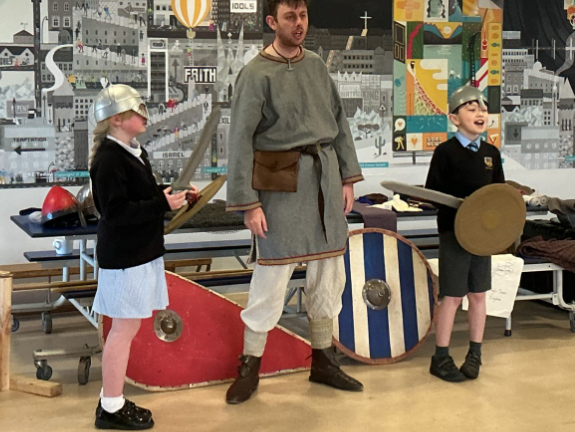
We enrich history through a wide range of high-quality experiences that bring learning to life. These include exciting school trips to historically significant sites, guest speakers who share expert knowledge, and hands-on artefact boxes that allow pupils to explore and investigate real and replica historical sources. We also run immersive in-school workshops where pupils take part in practical, engaging activities linked to historical periods and events. These experiences help pupils connect with the past in a meaningful and memorable way, strengthening both engagement and long-term learning.


