
Rauceby Church of England Primary School
Maths
Mathematics at Rauceby
At Rauceby Church of England Primary School, we believe mathematics is a foundation for daily life and future success. We aim to provide opportunities for all to see maths as an essential life skill that helps them make sense of the world, solve problems, and think logically and critically.
We aim to develop confident, curious and analytical learners who enjoy mathematics and are not afraid to explore, question and investigate. Through rich problem-solving and reasoning, children learn how to interpret situations, think deeply and apply their knowledge in meaningful ways.
Our maths curriculum is inclusive, engaging and ambitious, ensuring that every child can achieve mastery. Learning is active, practical and fun, with strong links to real-life contexts so children understand why maths matters beyond the classroom. We use a variety of approaches, investigations and challenges to support all learners and help them progress at their own pace
What we aim to deliver
Mathematics at Rauceby Church of England Primary School goes beyond correct answers, focusing on thinking, reasoning, exploration and enjoyment.
We value strong foundations in number and mathematical understanding, believing it is essential for children to become fluent in the fundamentals of mathematics. We intend to provide varied and frequent practice that allows children to become proficient in their procedural and declarative knowledge. Pupils will be able to apply knowledge to increasingly complex problems over time with accuracy and automaticity so that pupils develop conceptual understanding. Calculators should not be used as a substitute for good written and mental arithmetic. They should therefore only be introduced near the end of Key Stage 2 to support pupils’ conceptual understanding and exploration of more complex number problems.
We place a strong emphasis on real-life applications, investigations and rich mathematical talk, valuing the importance of oracy, so that pupils understand the relevance of mathematics and can articulate and reason clearly. We provide and foster opportunities for children to reason mathematically by following a line of enquiry, conjecturing relationships and generalisations, and developing an argument, justification or proof using mathematical language. Adaptations and support enable all learners to progress, while appropriate challenge ensures that pupils are stretched and ready to deepen their understanding.
We believe all children should leave our school as competent, confident problem-solvers who enjoy mathematics, demonstrate positive attitudes to learning and are well equipped with the skills needed for life, learning and future opportunities. We intend to provide rich problem-solving opportunities seated in real-life examples so children learn how to interpret situations, think deeply and apply their knowledge in meaningful ways. Pupils will be able to solve problems by applying their mathematics to a variety of routine and nonroutine problems. They will do so with increasing sophistication, including breaking down problems into a series of simpler steps and persevering in seeking solutions.

Oracy in Mathematics
As a Voice 21 school, we at Rauceby place a strong emphasis on oracy, recognising the vital role of spoken language in pupils’ cognitive, social and linguistic development. Mathematical talk is central to learning, with pupils exposed to rich language that supports the development of vocabulary and the ability to explain, justify and prove their thinking. Through structured discussion and the use of Voice 21 Talk Tactics, pupils are supported in articulating ideas clearly, deepening understanding and addressing misconceptions, ensuring secure foundations across the mathematics curriculum.
How we teach our Mathematics curriculum
At Rauceby, we want every learner to feel confident, curious, and ready to take on new challenges. Therefore, we are committed to delivering a high-quality mathematics education that is carefully structured, ambitious, and inclusive. Our curriculum gradually develops learning through a mastery approach, the outcome being the acquisition of knowledge and skills that enable each pupil to feel confident, curious, and ready to take on new mathematical experiences, as well as being equipped with the skills and understanding they need for future learning and everyday life.
Our approach draws strongly from Teaching for Mastery principles. We believe that all children can succeed in mathematics and that learning should be inclusive, supportive, and appropriately challenging. Through carefully designed lessons, thoughtful questioning, and purposeful practice, we ensure that every learner develops fluency, reasoning, and problem-solving skills. Daily opportunities for new learning are provided, alongside regular opportunities to consolidate and deepen understanding. We work closely with our local Maths Hub to continually strengthen our understanding of mastery approaches, refine our practice, and ensure that our children receive the highest quality mathematics education.

Lesson Structure
We place significant emphasis on clear progression and the logical sequencing of mathematical concepts, using the White Rose progressional framework to carefully sequence National Curriculum objectives into smaller, manageable steps and provide extended opportunities to deepen learning through intelligent practice. At times, teachers enhance this with high-quality resources from NCETM and other well-recognised schemes.
Our expectation is that all children access the same core concept, with the majority progressing at a similar pace. Pupils build securely on prior knowledge year by year, enabling them to deepen understanding and make meaningful connections across mathematical domains.
Each lesson begins with purposeful retrieval practice to consolidate prior learning and strengthen both procedural and declarative knowledge, ensuring firm mathematical foundations.
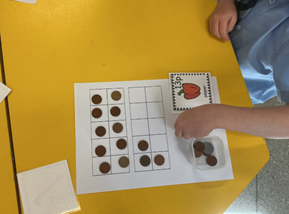
We recognise that delivering high-quality teaching is essential to securing the best outcomes for all pupils, particularly the most disadvantaged, and that the thoughtful use of manipulatives plays a vital role in this. Research shows that manipulatives are powerful tools for enabling pupils to engage deeply with mathematical ideas when used as part of effective teaching. There is shared belief at Rauceby that they are not simply a means to arrive at the correct answer; rather, when carefully selected and skilfully used, manipulatives strengthen pupils’ thinking, helping them to make sense of concepts and uncover underlying mathematical structures and generalisations. They provide valuable insight into pupils’ understanding, allowing teachers to assess depth of knowledge and address misconceptions. We are deliberate in choosing the most appropriate manipulatives to expose key concepts, and by embedding their use consistently across the whole school, we foster a culture of exploration, reasoning, and deep mathematical understanding for all learners.
Mathematics Beyond the Classroom
Beyond daily lessons, children regularly develop fluency and number sense through sessions such as Times Tables Rock Stars, Numbots, and Mastering Number. This allows children to develop a rapid recall of facts which they can automatically apply in later learning as they are embedded in the long-term memory, reducing cognitive overload.
They are also provided with rich opportunities to apply their learning through real-life contexts, investigations, and purposeful mathematical talk. Through explaining their reasoning, exploring multiple strategies, and engaging in collaborative discussion, pupils develop resilience, curiosity, and the confidence to approach new and increasingly complex challenges. We proudly take part in the Maths Challenge set by Sir William Robertson Academy each year where some of our top mathematicians from year 5 and 6 compete against other schools to show off what they have learnt, applying their skills to complex problems.

Progression maps
- White Rose Ready to Progress Progress MapPDF File
- Place ValuePDF File
- Addition and SubtractionPDF File
- Multiplication and DivisionPDF File
- FractionsPDF File
- Ratio and ProportionPDF File
- AlgebraPDF File
- MeasurementPDF File
- Geometry - properties of shapePDF File
- Geometry-position, direction and movementPDF File
- StatisticsPDF File